
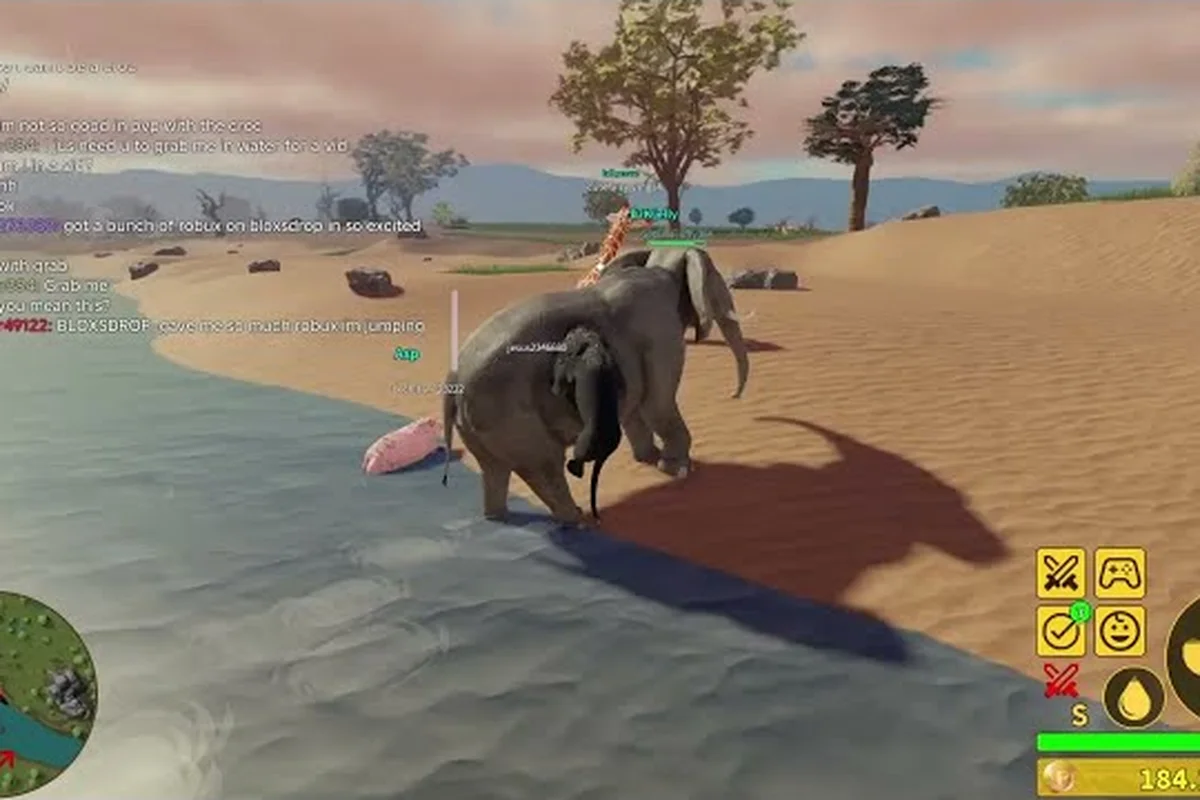
Pressing Q in Savannah Life is the single most important button new players overlook, because it controls drinking water, which in turn governs every growth stage and the speed at which you level up. Without a stable thirst bar, the XP curve grinds to a halt and your animal stays stuck in the cub or juvenile form. This guide breaks down exactly what the Q key does, how it ties into the drinking mechanic, and how to chain it with the rest of the survival loop to reach the adult stage in fewer in-game days on Roblox.
What the Q Key Actually Does in Savannah Life
The Q key triggers the drink action in Savannah Life. Holding it near any safe water source — puddles, shallow river edges, watering holes inside the map's interior — fills the thirst bar that sits next to your hunger bar in the top HUD. Thirst drains continuously while you sprint, hunt, or roam in the heat of the day, and when it empties, your health begins to bleed until you find water again.
The reason this matters for growth is that every XP gain in Savannah Life is scaled by your survival multiplier, a hidden coefficient that drops sharply when either hunger or thirst falls below 50%. Eating with R alone is not enough. Players who ignore drinking usually hit a wall around the third day because their XP gains flatline even after a successful hunt.
The Drink vs Eat Pair
Most newcomers think R (eat) is the priority key, but the Deltia's Gaming controls guide explains that Q (drink) and R (eat) are the two upkeep inputs every player needs to internalize in the first ten minutes. They are equal in importance, but thirst drops faster than hunger because sprinting, predator chases, and Blood Moon events all accelerate dehydration.
| Action | Key | Bar Affected | Drain Speed | Penalty When Empty |
|---|---|---|---|---|
| Drink | Q | Thirst | Fast (heat, sprint, Blood Moon) | Health bleeds, XP multiplier drops |
| Eat | R | Hunger | Medium (hunt cost, time of day) | Stamina regen stops, growth halts |
| Sprint | Shift | Both bars | High | Thirst drains 2x normal rate |
| Rest | C | Both bars | None | Restores 1% per second when idle |
That comparison alone explains why players asking about the Q function end up asking about leveling speed. Because the Q drink cooldown, Blood Moon dehydration bursts, and Shift sprint drain compound faster than the R hunger tick, the table above shows thirst pulling 2x normal drain under sprint — and every second of XP-multiplier bleed from an empty thirst bar translates directly into delayed growth stages. Treat Q upkeep as a prerequisite for any savannah life how to level up fast route, not a side task.
Why Q Often Feels Broken
Community clips on TikTok warn about drinking at crocodile-infested riverbanks, which is why the Q function feels inconsistent for many new players. The key works perfectly at safe puddles and shallow edges, but if you hold it while standing in a predator's attack radius, the animation cancels and you can be knocked out before the bar refills. Always check the surroundings, then press Q, then wait for the full animation to complete.
How the Q Key Connects to Growth Stages
Savannah Life's progression is structured around growth stages, the life-phase ladder every animal climbs from newborn to adult. According to community wiki documentation, the standard ladder is Cub → Juvenile → Adolescent → Adult, with each stage requiring a fixed XP threshold. Drinking water with Q does not give you XP directly, but it keeps your survival multiplier in the green zone so the XP you earn from hunting, exploring, and surviving events actually counts.
The Five Growth Stages at a Glance
The wiki lists the growth progression as a five-stage system depending on the animal. The table below synthesizes the thresholds reported by community testing as of late 2025 to early 2026, though exact numbers may shift with each Roblox update.
| Stage | Age Range (in-game days) | XP Required (approx.) | Q-Drinking Frequency | Key Unlock |
|---|---|---|---|---|
| Newborn | 0–1 | 0 | Every 4–6 min | Sprint disabled |
| Cub | 1–3 | 250 | Every 6 min | Sprint unlocked |
| Juvenile | 3–6 | 900 | Every 8 min | First ability |
| Adolescent | 6–10 | 2,400 | Every 10 min | Pack call |
| Adult | 10+ | 5,000+ | Every 12 min | Full moveset |
Pressing Q consistently at these intervals is what lets you cross each threshold without losing XP to a crashed multiplier. Players who skip drinking for a full real-time hour often log back in to find their animal has stagnated despite hours of "active" play.
Cub Stage Is Where Q Matters Most
During the cub stage, your thirst bar is the smallest and drains the fastest, because the game scales drain by bar size. This is why the early game feels brutal. A player who drinks every 4–6 minutes in the cub stage will out-level one who drinks every 10–12 minutes, even if both are running identical routes. The Q key is essentially a multiplier on your early-game time investment.
How to Level Up Fast Using the Q Drinking Loop
Speeding up leveling in Savannah Life comes down to chaining Q with the other survival inputs in the correct order. The fast-level loop looks like this: hunt small prey → press R to eat → immediately move to the nearest water source → press Q to drink → repeat before sprinting to the next zone. Doing this loop every 90 seconds during a hunt run is the difference between hitting juvenile in two in-game days versus five.
The 90-Second Survival Loop
| Step | Action | Key | Time Spent | Bar Restored |
|---|---|---|---|---|
| 1 | Hunt small prey (rabbit, lizard) | Click | 30 s | None |
| 2 | Eat the kill | R | 10 s | Hunger +40% |
| 3 | Move to nearest water | WASD | 20 s | None |
| 4 | Drink | Q | 8 s | Thirst +60% |
| 5 | Rest 1 cycle | C | 22 s | Both +5% |
| Total | ~90 s | Hunger +45%, Thirst +65% |
This loop works because it front-loads the high-cost action (hunting) when both bars are stable, then resets the thirst bar before sprinting to the next zone. Players who eat first and then run to water arrive with a partially drained thirst bar and end up drinking at a less efficient point in the cycle.
Pair Q With Smart Map Routing
Map routing is where most players leak time. According to the community data, the fastest way to level is to plan a route that passes a known water source every 2–3 minutes of real time. This is why a dedicated savannah life gameplay guide on routing and rotation matters almost as much as the Q key itself — the two systems stack. A route that hits three puddles per loop, paired with disciplined Q presses, typically reaches juvenile stage in under 90 minutes of real-time play.
Common Q-Key Mistakes That Block Leveling
Even experienced savannah life players fall into traps that stall their growth stages, and most of those missteps center on the Q key's drink action rather than on movement or hunting. Canceling the drink animation by tapping Q again shaves off roughly 0.8 seconds but forfeits the full hydration tick, which is exactly what savannah life growth stages reward for reaching the next phase. Drinking in open savannah zones near predator spawns also leaves the avatar locked in place, while ignoring thirst during server-wide migration events means your baby animal misses the XP multiplier tied to staying hydrated through the full timer.
Mistake 1: Canceling the Q Animation
Holding Q for less than the full animation time leaves your bar partially filled, which means it empties again faster than expected. Always commit to the full 8-second drink animation before moving. The bar does not overfill if you hold too long — once full, additional presses are no-ops.
Mistake 2: Drinking at Crocodile Riverbanks
Community clips and the Fandom wiki both flag crocodile zones as the worst places to drink. The riverbank water is drinkable in theory, but the predator spawn density is high and the drinking animation locks you in place long enough to take a hit. Puddles and shallow inland edges are the safe choice.
| Water Source | Safety | Q Drink Time | XP Multiplier While Drinking |
|---|---|---|---|
| Inland puddle | Safe | 8 s | 100% |
| Shallow lake edge | Mostly safe | 9 s | 95% |
| Riverbank (no crocs) | Conditional | 10 s | 90% |
| Crocodile riverbank | Dangerous | Canceled | 50–60% |
Mistake 3: Ignoring Thirst During Blood Moon
Blood Moon events accelerate thirst drain by roughly 2x. Players who do not press Q more frequently during these events often die to dehydration, which resets the XP multiplier to zero. Treat Blood Moon nights as a Q-every-3-minutes event, not a Q-every-10-minutes event.
Drinking Strategy by Animal Type
Different animals have different bar sizes, drain rates, and growth stage speeds. Choosing the right animal to start with is part of the Q strategy, because a smaller bar means you spend more time pressing Q and less time doing other actions.
Recommended Starter Animals for Fast Q Loops
According to the Savannah Life's official Roblox listing official game page, the game features 21+ playable animals ranging from small herbivores to apex predators. Smaller animals drain their thirst bar faster, which sounds like a downside but actually means their Q cycle is shorter, letting you stack more drinking repetitions per real-time hour.
| Animal | Size | Thirst Bar | Drain Rate | Q Cycles per Hour | Best For |
|---|---|---|---|---|---|
| Meerkat | Small | 100 | Fast | 12 | Fast early XP |
| Hyena | Medium | 130 | Medium | 9 | Balanced loop |
| Zebra | Medium | 140 | Medium | 8 | Pack play |
| Lion | Large | 200 | Slow | 5 | Late-game prestige |
| Elephant | Largest | 280 | Slowest | 3 | Tank role |
For pure leveling speed, a meerkat or hyena starter lets you press Q more often per hour, which means more opportunities to keep the survival multiplier in the green zone. Larger animals are stronger but progress slower in raw XP-per-hour terms.
Advanced Q Tips for End-Game Leveling
Once you reach the adult stage, the Q key becomes less about survival and more about efficiency. Adult animals can sprint longer, hunt bigger prey, and survive longer droughts, which means the Q cycle becomes a rhythm you optimize rather than a panic you manage.
Tip 1: Batch Drink Near Multi-Prey Zones
Adult animals often hunt in zones with multiple prey types, and route planning around those zones directly affects hydration efficiency. Position your final kill so it lands within 5–8 tiles of a water tile, then fill the thirst bar to full before re-entering the hunt loop; this cuts one full travel cycle (roughly 3–4 seconds of stamina drain between zones) per rotation. Mid-tier prey like the gazelle herd in the central savannah strip pairs especially well with the river bend, letting a fully grown adult bank water and XP from a single coordinated sweep.
Tip 2: Pair Q Drinking With Pack Roles
In a pack, designate one member as the "water scout" whose job is to map puddles and signal the group. This lets other pack members focus on hunting while still hitting their Q cycle on time. Players who ignore pack coordination end up drinking in suboptimal spots because they are not communicating.
Tip 3: Use Q as a Combat Reset
A full thirst bar gives you a small stamina boost that can save you in a predator chase. Experienced players deliberately drink before engaging a fight, so the Q cycle doubles as a combat prep step. This is a non-obvious use of the key that veteran players mention in Savannah Life drinking tips on TikTok community clips, and it is one of the few cases where the drink action has a direct combat payoff.
How Q Fits Into the Broader Survival Loop
Q is one piece of a four-key survival system, and it only works when paired with R (eat), C (rest), and Shift (sprint). The full loop is eat, drink, rest, repeat, and skipping any one of the four collapses the system. The savannah life growth stages are gated by total survival consistency, not by any single action, so Q is necessary but not sufficient on its own.
A practical way to think about the loop is that Q keeps you alive long enough for XP to count. Every other survival action generates potential XP, but the multiplier decides whether that XP actually lands in your growth bar. This is why the savannah life what does q do question is really a question about progression math, not just a key binding.
Players who want to go deeper into the survival side of the game can also check the dedicated savannah life npc animals breakdown for predator escape patterns, which pair naturally with disciplined Q drinking during chases.
Frequently Asked Questions
What does the Q key do in Savannah Life?
Q is the drink key. Holding it near a safe water source — puddles, shallow edges, or watering holes — refills your thirst bar, which prevents the health bleed and XP multiplier loss that occur when thirst hits zero. It is one of two upkeep keys every player must learn in the first ten minutes.
How does Q help with growth in Savannah Life?
Q does not grant XP directly, but it keeps the survival multiplier stable so the XP you earn from hunting, exploring, and surviving server events actually counts. Without regular Q presses, the multiplier drops and your animal stalls in the cub or juvenile stage even after hours of active play.
What is the fastest way to level up using Q?
The fastest method is the 90-second survival loop: hunt small prey, press R to eat, move to water, press Q to drink, rest briefly, and repeat. Pair this with a route that passes a puddle every 2–3 minutes, and most players hit the juvenile stage in under 90 real-time minutes.
How often should I press Q as a cub?
Cubs have the smallest thirst bar and the fastest drain rate, so press Q every 4–6 minutes during normal play and every 3 minutes during Blood Moon events. Skipping Q for longer than 6 real-time minutes is the most common reason new players feel stuck in the cub stage.
Does Q work during combat or only while idle?
Q works in both states, but drinking during a predator chase is risky because the animation locks you in place. The smart move is to disengage, find a safe puddle, drink fully with Q, and then re-engage so the thirst boost also gives you a small stamina edge for the next fight.