
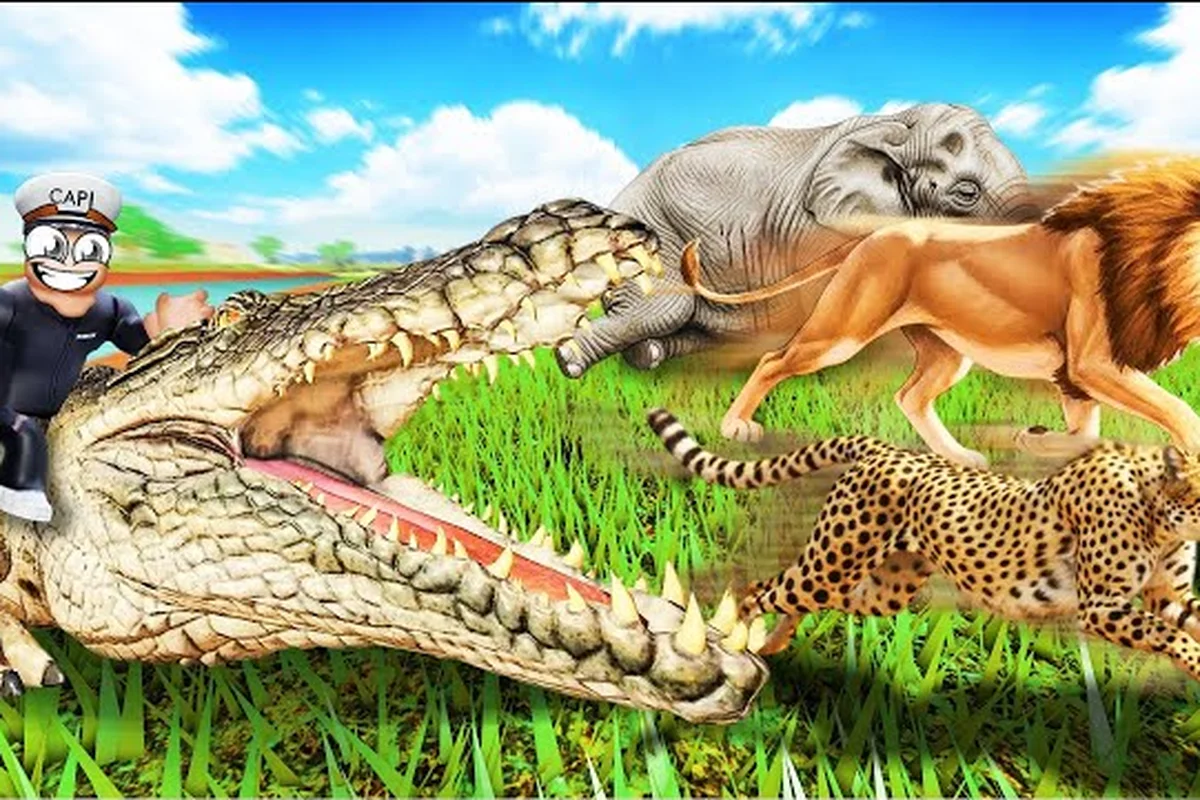
Knowing exactly where the river apex predator shows up makes every other choice in Roblox Savannah Life easier. The official Savannah Life page on Roblox confirms crocodiles live along the waterways, and the developer's NOYO Productions Savannah Life page describes the Nile Crocodile as a river ambusher. This guide maps every confirmed and community-reported spawn so you can find a drinking path, cross a river safely, or lock in the apex lifestyle from the first match you join.
Crocodile Spawn Map Across the Savannah Biomes
The crocodile population in Savannah Life is concentrated wherever large water touches a prey trail. The map is built around three river corridors and two swamp edges, and each corridor behaves a little differently depending on depth, current, and how close it sits to the herd migration paths. If you are still learning the broader geography, the savannah life map guide lays out every named zone, but the breakdown below focuses purely on croc territory.
Main River Corridor (Center Map)
The Main River is the longest water feature in the game, cutting roughly from the northwest highlands down to the southeast delta. According to community clips and TikTok map tours, the crocodile's natural spawn territory sits along the central stretch of this river, where the banks are muddy and the drinking paths from the open savannah curve in. Spawn density is highest near:
-
North Bend Pool — slow water, deep channel, two hippo-neutral banks
-
Central Crossing Shallows — the spot most herd animals use to drink, and where ambush tension is highest
-
Reedy Outlet — where the river empties into the southern marsh, often crowded with smaller prey
Western Swamp Edge
The Western Swamp is a shallow, lily-pad-choked offshoot of the Main River. Reported by players as a secondary spawn cluster, the swamp is the best place to find a croc when the Main River is full of higher-tier players. The water is shallower, the visibility is lower, and the spawn timer between crocodile players feels shorter, which is why newer Nile Crocodile mains often grind here before moving to the main channel.
Southern Delta Mouth
The Southern Delta is where the Main River opens into a wide, brackish flatland before exiting the playable area. Crocodile spawns here are less common but tend to be the largest adults because the water depth supports them. Drinking animals rarely come this far south, so this is more of a patrol zone than an ambush zone, and the crocs that spawn here are usually veterans defending territory rather than newcomers looking for a first meal.
How Spawn Behavior Changes by Time of Day
Community testing suggests that croc density shifts with the server day-night cycle. During daylight, spawns cluster around drinking paths because herbivores flood the banks. At dusk, the spawns thin out and shift toward the swamp edges, where the ambient light makes ambushes easier. At night, the river becomes the dominant croc territory again, but the threat curve flips because most prey animals are asleep and the only targets are the players still trying to drink, which is exactly when the Nile Crocodile's underwater grab dominates the encounter.
| Time of Day | Primary Spawn Zone | Density | Prey Activity |
|---|---|---|---|
| Day | Central Crossing Shallows | High | Herds drinking at the bank |
| Dusk | Western Swamp Edge | Medium | Low, scattered grazers |
| Night | Main River Corridor | High | Solo drinkers, vulnerable prey |
| Dawn | Southern Delta Mouth | Low | Returning herd migration |
Savannah Life Spawn Locations Beyond the Crocodile
Crocodiles share the map with lions, leopards, hyenas, and a long list of smaller animals, and their spawn points rarely overlap. Understanding the full distribution helps a croc player know where rivals are likely to be, and it helps a prey player avoid stacking threat zones. The table below maps the major biomes and the species that anchor each one, based on community reports and the Savannah Life Fandom wiki.
| Biome | Anchor Species | Croc Presence | Drinking Path? |
|---|---|---|---|
| Main River | Nile Crocodile | Very High | Yes |
| Western Swamp | Nile Crocodile, Hippo | Medium | Yes |
| Eastern Grasslands | Lion, Gazelle | None | Seasonal stream |
| Southern Delta | Nile Crocodile | Low | Salt flat, no |
| Acacia Woodland | Leopard, Giraffe | None | None |
| Northern Plateau | Hyena, Jackal | None | Rock pool only |
The key takeaway is that any zone without a permanent water feature is effectively a no-croc zone, which is why most players treat the Main River and the swamp edges as the only places to worry about an underwater grab. For prey species and how they overlap with croc territory, the savannah life all animals breakdown catalogs the full list, including which ones are coin-locked and which are free at the start.
Where Drinking Paths Create Ambush Points
Every named river crossing in the savannah has at least one drinking path, which is a narrow strip of bank that prey animals use repeatedly throughout the in-game day. Crocodile players learn these paths because they guarantee a target, while prey players learn them because they signal exactly where the croc spawns are densest. The three most-confirmed drinking paths in the game are:
-
North Bend Pool bank — wide, shallow approach, favored by zebra and wildebeest
-
Central Crossing Shallows trail — the busiest intersection in the game, multiple species converge
-
Reedy Outlet flats — a quieter path used mostly by smaller antelope
Savannah Life Best Spots to Drink Safely
Even if your goal is not to play as a crocodile, you still need to drink, and almost every safe approach to a water source depends on knowing where the crocs spawn. The best spots to drink are not the closest water; they are the water sources that sit just outside a crocodile's ambush angle, with at least one clear escape route, and ideally with a herd nearby so a croc has to pick a target other than you.
Top Safe Drinking Pools
-
Acacia Pool — a small, shaded rock pool on the Northern Plateau with no permanent croc spawn. According to community data, the only risk is a passing lion pride, but the cover is dense enough to slip away.
-
Plateau Cascade — a stepped water feature fed by runoff. It is shallow, narrow, and very loud when something moves through it, so crocs avoid it because ambushes do not work in moving water.
-
Ephemeral Rain Pool — appears only after the storm cycle, used by migratory herds. The water is temporary, so croc spawns here are rare and usually the result of a player pushing a croc character far from the river.
Ranking the Safest Crossing Points
The table below scores the most-used crossing points by croc threat, escape options, and water clarity. A lower croc score is safer for prey, while a higher escape score means more cover to break line of sight.
| Crossing Point | Croc Threat | Escape Options | Water Clarity |
|---|---|---|---|
| Acacia Pool | None | 3 (rock, grass, plateau) | Clear |
| Plateau Cascade | None | 2 (slope, scrub) | Crystal clear |
| North Bend Pool | Very High | 1 (single muddy bank) | Murky |
| Central Crossing | Extreme | 1 (open sand) | Murky |
| Reedy Outlet | High | 2 (reeds, swamp) | Tannin-stained |
When to Drink During a Storm
The storm cycle is a brief but high-value window. During a storm, the river rises, visibility drops, and the crocodile's underwater grab becomes much harder to read. Prey players who want a relatively safe drink tend to time their approach to the first ten minutes of the storm because most croc players have already moved to the higher banks to avoid being swept downstream. Community testing suggests this window is short, and by the second half of the storm, the crocs have repositioned and the drinking paths are again heavily patrolled.
Savannah Life Explore All Areas and Reach the Master Explorer Badge
Master Explorer is one of the milestone badges in Savannah Life, and it is the only one that depends almost entirely on map knowledge. According to the badges guide, the badge requires you to visit every named biome on the map at least once, and the trick is that some of the biomes are only accessible from specific entry points, including the crocodile zones.
Required Biomes for the Master Explorer Badge
-
Main River Corridor — easy, just walk to the central bank
-
Western Swamp Edge — accessible from the south, but watch for crocs
-
Southern Delta Mouth — only reachable by following the river south
-
Acacia Woodland — open, safe, no croc threat
-
Northern Plateau — high ground, requires a stamina-efficient path
-
Hidden Reeds Grove — tucked between the swamp and the delta, easy to miss
-
Sunken Termite Mound Cavern — a small cave system, secret location, only visible when the water is low
Secret Locations Most Players Miss First
Community data and player reports point to a handful of secret locations that do not show up on the standard map. These are tucked behind Acacia groves, inside dry riverbeds, and along the swamp edges where the croc spawns are densest. Most of them are easy to find if you already know where to look, and impossible to find if you do not.
| Secret Location | How to Find It | Nearby Croc Spawn? |
|---|---|---|
| Sunken Termite Mound Cavern | Walk the dry bed behind North Bend | Yes |
| Reeds Grove alcove | Push through the swamp edge at dusk | Yes |
| Acacia hollow | Climb the largest baobab in the woodland | None |
| Plateau rock overhang | Follow the cliff line north of the cascade | None |
| Delta salt flat crack | Cross the southern flats at low tide | Low |
The Role of Crocodile Territory in the Master Explorer Path
Because the Master Explorer badge requires you to enter at least three croc-active zones, the river is unavoidable. The most efficient route is to start in the Acacia Woodland, loop north through the plateau, drop down to the Main River at Central Crossing, sweep the swamp edge, push south into the delta, and finish at the Reeds Grove. The route touches every required biome and limits the time spent in croc territory to roughly a third of the total run. If you are tracking the badge in a single session, bring a stamina-friendly prey animal and avoid drinking at the river until you are safely past the central zone.
Savannah Life Secret Locations and Hidden Areas Around the River
Hidden areas in Savannah Life are the zones that do not appear on the standard spawn list, do not get flagged by the in-game map, and usually require a specific movement pattern to reach. Crocodile players tend to discover more of them than prey players because they spend more time in the water, where the camera and the collision boundaries behave differently.
River-Only Hidden Areas
-
Submerged Log Tunnel — a hollow log on the riverbed that you can swim through to access a small cave behind the bank. It only opens when the water level is at the medium setting, which happens about 15 minutes into each in-game day.
-
Croc Nesting Mound — a raised dirt mound above the high-water mark, only visible from the water. Community reports suggest it has a small loot cache and a unique cosmetic for the croc player who reaches it first.
-
Drinking Path Overlook — a narrow ledge above the Central Crossing Shallows that lets a prey player scout the river before committing to a drink. It is the only safe vantage point with line of sight to the main ambush channel.
Swamp-Only Hidden Areas
-
Lily Pad Maze — a network of wide lily pads in the Western Swamp. The pads support a light prey animal but collapse under a full-grown croc, so it is a useful escape route for prey and a dead end for an overcommitted croc.
-
Mangrove Tunnel — a covered waterway that connects the swamp to the southern delta. It is the shortest path between the two zones, and the only route that bypasses the open delta where lions often patrol.
Quick Reference: Best Routes by Playstyle
| Playstyle | Priority Zone | Reason |
|---|---|---|
| Croc main | Main River, Western Swamp | Highest prey traffic |
| Prey main | Acacia Pool, Plateau Cascade | No croc threat |
| Badge hunter | Acacia → Plateau → River → Swamp → Delta | Covers all required biomes |
| Explorer | Reeds Grove, Sunken Termite Mound | Required for Master Explorer |
Frequently Asked Questions
Where exactly does the Nile Crocodile spawn in Savannah Life?
The Nile Crocodile spawns along the Main River Corridor, the Western Swamp Edge, and the Southern Delta Mouth, with the highest concentration near the North Bend Pool and the Central Crossing Shallows. Community testing places roughly two-thirds of the population in the central river stretch because the drinking paths from the open savannah funnel prey straight to those banks.
What is the best spot to drink without being ambushed?
Acacia Pool on the Northern Plateau is the best safe drinking spot because it has no permanent crocodile spawn, three separate escape routes, and clear water so you can see threats early. The Plateau Cascade is a close second, and the Ephemeral Rain Pool is the safest option during a storm cycle when it briefly fills with runoff.
Do crocodile spawns change with the day-night cycle?
Yes, crocodile density shifts between zones depending on the in-game time. Day spawns cluster around the busiest drinking paths, dusk spawns thin out and drift to the swamp edges, and night spawns return to the Main River because that is where the fewest prey animals are active, which makes every solo drinker a high-value target.
What biomes do I need to visit for the Master Explorer badge?
The Master Explorer badge requires a visit to the Main River Corridor, the Western Swamp, the Southern Delta, the Acacia Woodland, the Northern Plateau, the Reeds Grove, and the Sunken Termite Mound Cavern. The Reeds Grove and the Sunken Termite Mound are the two most commonly missed biomes, and both sit inside the crocodile's active range.
Are there any secret locations only crocodile players can reach?
Yes, the Submerged Log Tunnel and the Croc Nesting Mound are only accessible by swimming, which makes them effectively crocodile-exclusive. The Drinking Path Overlook is a third hidden area, but it is reachable by any player willing to climb the cliff face above the Central Crossing Shallows, and it is the best scouting position for prey players planning a safe river crossing.